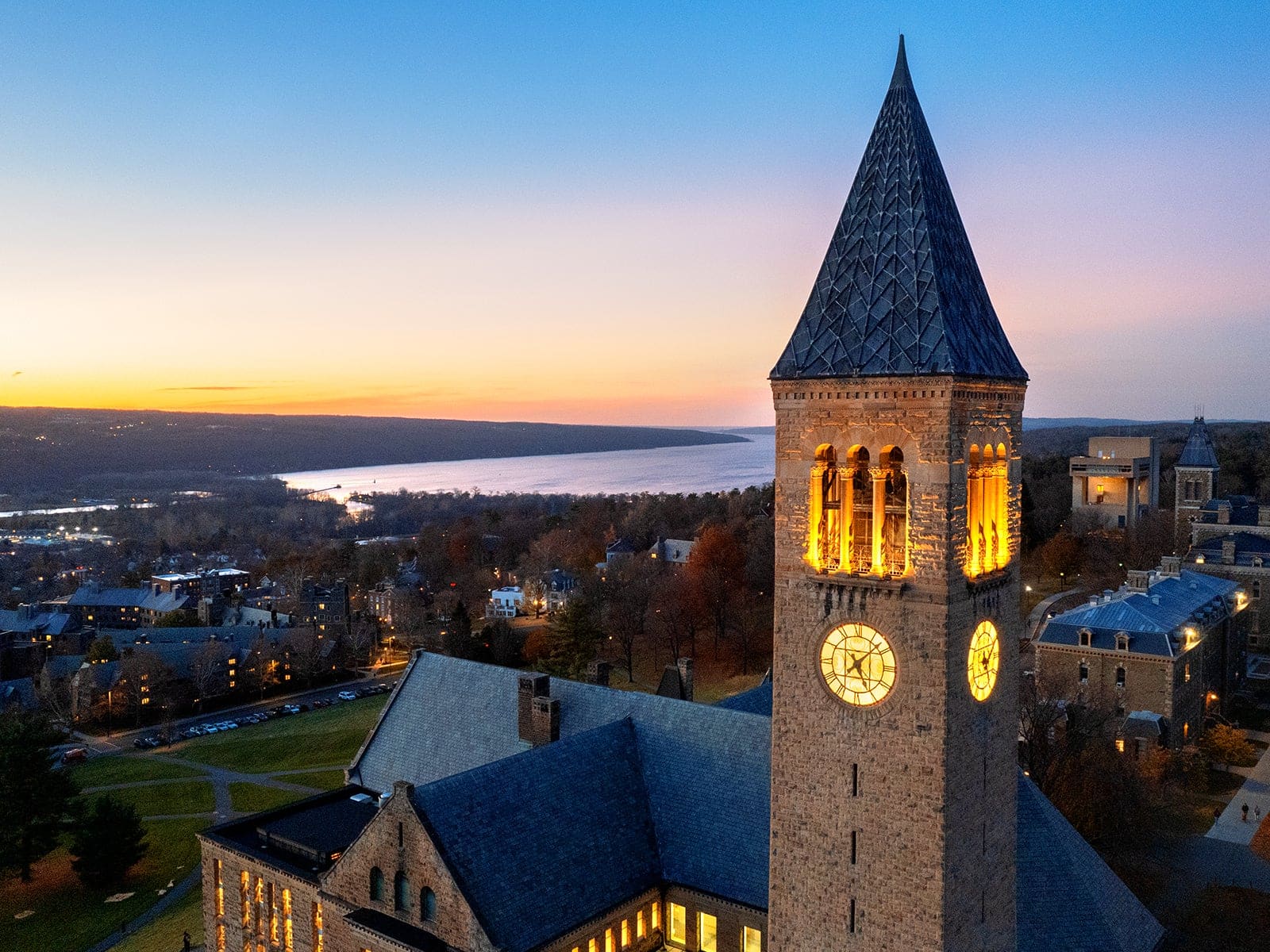
Cornell University’s Committee on the Future of the American University released its final report Tuesday, capping a year-long effort to chart a path for higher education amid mounting pressure from artificial intelligence, strained federal relationships, and eroding public trust. It echoes similar sentiments to those laid out in Yale University’s faculty report, released in April.
Provost Kavita Bala convened the 18-member faculty committee in fall 2025, asking it not simply to defend the university as it currently exists but to imagine what it could become over the next fifty years. The committee — co-chaired by Ariel Avgar, Phoebe Sengers, Praveen Sethupathy and Adam T. Smith — spent the year gathering input from more than 6,000 stakeholders, including students, faculty, staff, administrators, alumni and government officials, through town halls, webinars and individual meetings.
The resulting report and accompanying vision statement center on a single proposed purpose for the university: serving as a “human-centered, integrated learning ecosystem” built to cultivate sound judgment. To get there, the committee outlined five commitments — to rigorous deliberation and discourse, to two-way public engagement, to research innovation and resilience, to a more connected campus community through what it calls “academic civics,” and to greater coordination across the university’s far-flung units.
The report frames today’s disruptions as more than a passing storm. It argues that the modern research university, or “multiversity,” has become so large and specialized that its departments and missions have drifted apart even as external pressures — AI’s disruption of teaching and research, declining federal support, and years of eroding public confidence — hit simultaneously. Rather than shrinking the university’s ambitions in response, the committee argues Cornell should realign its many functions around a shared sense of purpose.
Bala endorsed both documents in a message to the community, writing that the committee’s central question — “Is a university education still worth it?” — deserves, in her words, “a resounding yes.”
Notably, the committee did not always agree. Sethupathy said the group deliberately avoided papering over its internal disagreements, calling difficult conversations “a feature, not a bug” of the process. That tension surfaces most visibly in the report’s final chapter, where individual committee members contributed signed reflections on contested questions — including viewpoint diversity, DEI and the conditions needed for open campus discourse — rather than forcing false consensus.
Sengers emphasized that the push for coordination across university units is not a call for centralization, saying the goal is not to “create a monoculture where all the diversity is gone.”
Avgar pointed to the scale of the outreach effort itself as a distinguishing feature of the process, noting the committee made “a robust effort to engage in meaningful ways” with the community both inside and outside Cornell.
The report also proposes a new “Future of the American University Forum” to carry the committee’s work forward, along with dozens of specific recommendations touching admissions, tuition pricing, doctoral training, research funding and campus governance.
Smith called the current moment “an all-hands-on-deck situation,” saying the report’s impact will depend on how many people across campus engage with — and challenge — its findings. Cornell now plans to translate the recommendations into a formal strategic plan, with further details expected in the coming weeks.