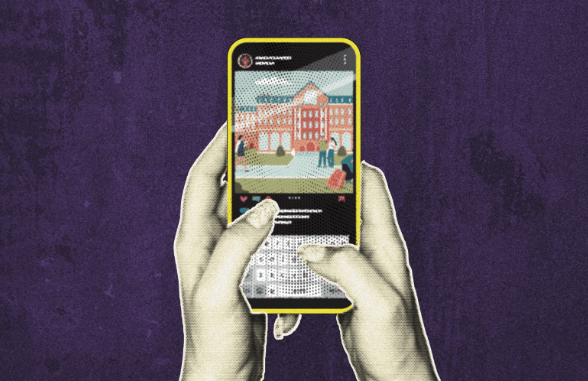
Faculty and staff are becoming higher education’s most trusted brand ambassadors
When a professor posts a plain-language thread on social media about a new study, or a financial aid director explains a policy change on LinkedIn, the message can travel farther and land with more credibility than the university’s official account. It’s not just anecdotal. Employees increasingly are functioning as an institution’s public voice.
That reality creates a modern higher ed tension: colleges need authentic, human messengers, but they also carry legal, reputational, and academic freedom obligations that do not fit neatly inside a “please share this post” culture.
In trust-starved public life, employers have become unusually influential. The 2024 Edelman Trust Barometer Special Report: Trust at Work found that “my employer” was the most trusted institution among employees in its seven-market global dataset, ahead of business in general, government, and the media. According to Edelman, this trust dynamic has persisted as information has become more politicized and communities more polarized.
For universities, that advantage can show up in recruitment, fundraising, research visibility, and crisis communications. But it works best when the employee voice is supported rather than forced—and when guardrails are designed with faculty rather than simply handed down from a compliance office.
Individual Voices Often Surpass Company Accounts
Social platforms are built for people, not logos. A Refine Labs analysis comparing posts from seven employees’ personal LinkedIn profiles to the company’s LinkedIn page found the personal profiles averaged 2.75 times more impressions and five times more engagement per post during the same period, despite having fewer followers on average. The results align with a basic behavioral truth: audiences engage more with people than brands.
LinkedIn’s own marketing guidance frames employee advocacy as employees promoting their organization through their personal social channels and networks, adding that those messages are perceived as more credible and authentic. Employees also tend to have much larger personal networks than institutional follower numbers might suggest, which can amplify further when they choose to share posts.
Higher education has an additional advantage. Faculty expertise is, by design, evidence-driven. When that expertise is translated into accessible social media posts, it can serve the public mission and strengthen institutional reputation at the same time.
The University of Michigan’s Institute for Healthcare Policy and Innovation (IHPI), for example, publishes guidance encouraging research professionals to choose one or two platforms, use layman’s language for public audiences, and share evidence carefully. IHPI notes that researchers use platforms such as LinkedIn and X to disseminate their work, connect with policymakers, and fight misinformation. It also emphasizes that communications staff can be a tremendous support when researchers are unsure about sharing.
The Academic Freedom Line Leaders Cannot Ignore
Universities cannot treat employee social media as purely brand management, especially for faculty. The American Association of University Professors (AAUP) has warned that overly restrictive institutional social media policies can limit academic freedom. In a statement on these policies, the organization says institutions can provide guidance for faculty posting in an official capacity, but they must recognize that faculty speech on matters of public concern is subject to academic freedom principles.
The AAUP also recommends working with faculty to develop social media policies and acknowledges that social media can blur the distinction between private and public communication.
For presidents, provosts, and communications leaders, the practical takeaway is not “hands off.” It is co-design. Policies drafted without shared governance buy-in may undermine legitimate public scholarship and spark conflict at the first controversy.
Encouraging Thought Leadership Without Inviting Institutional Risk
The goal is not to turn every employee into an influencer. It is to make it easy for willing faculty and staff to share their work safely, accurately, and in ways that advance institutional priorities.
A workable framework includes:
- Define two lanes: official speech and personal scholarship. Universities should clearly define who speaks for the institution, what requires approval, and what constitutes personal expression.
- Build an enablement program, not a compliance seminar. Offer short trainings on plain-language research translation, accessibility basics (such as alt text), and platform norms. IHPI’s guidance highlights practical steps such as using audience-first language, visuals, and consulting communications professionals when unsure.
- Create a low-friction content library. Provide optional, ready-to-share assets: approved graphics, linkable research summaries, key statistics with citations, and suggested wording for sensitive topics. Make it easy for employees to add their own expertise rather than copy and paste a press release.
- Plan for harassment and pile-ons. The AAUP notes that targeted harassment tied to social media posts has shaped institutional responses and policy debates. Leaders should pre-plan escalation paths, security support, and doxxing response protocols, especially for public-facing scholars.
- Protect what must be protected. Faculty and staff need clear reminders about FERPA (Family Educational Rights and Privacy Act), patient privacy in clinical contexts, research embargoes, conflicts of interest, and confidential internal information. Guardrails should be specific and scenario-based, not vague warnings that discourage participation.
- Measure what matters. If employee voices are intended to support enrollment or reputation goals, track outcomes such as referral traffic to program pages, media inquiries sparked by posts, event registrations, or increases in qualified job applicants. Personal posts may outperform brand pages, but leadership still needs metrics tied to institutional priorities.
The Leadership Mindset Shift
The social media campus is an ecosystem. The strongest institutional brands increasingly resemble a chorus: researchers explaining why their findings matter, student affairs leaders showing what support looks like, and staff members translating complex work into human language.
In 2026, the strategic question is shifting from “How do we control the message?” to “How do we responsibly support the people our audiences already trust?”
Most university employees were never trained to communicate publicly outside of peer-reviewed journals or internal reports.
Start With Permission, Not Pressure
One of the fastest ways to undermine employee advocacy is to mandate it. Effective institutions make participation optional and frame it as professional development, not brand compliance.
Build a Free, Internal Content Creation Course
A short, voluntary content creation course designed specifically for higher education professionals can be an effective, low-cost intervention. It should focus on translation, accuracy, and boundaries rather than influencer culture.
Create an Opt-In Amplification System
Institutions often want to amplify employee posts but lack a respectful mechanism to do so. The solution is consent-based amplification.
A simple model includes:
- An internal form or Slack channel where faculty and staff can flag posts they are comfortable having reshared.
- Clear criteria for resharing, such as relevance to institutional priorities or public education value.
- Light editing support, if requested, without altering the original voice.
According to LinkedIn, employee advocacy works best when employees retain ownership of their voice and participation feels authentic rather than transactional.
The Long-Term View
Colleges and universities already house extraordinary expertise. The challenge is not creating content. It is building systems that help people share what they know responsibly, safely, and in ways that strengthen both individual careers and institutional trust.
In a fragmented information environment, the institutions that thrive will not be the loudest. They will be the ones that empower their most credible voices to speak—and know when to stand behind them.