Harvard partnership helps coalition build on research impact and national influence
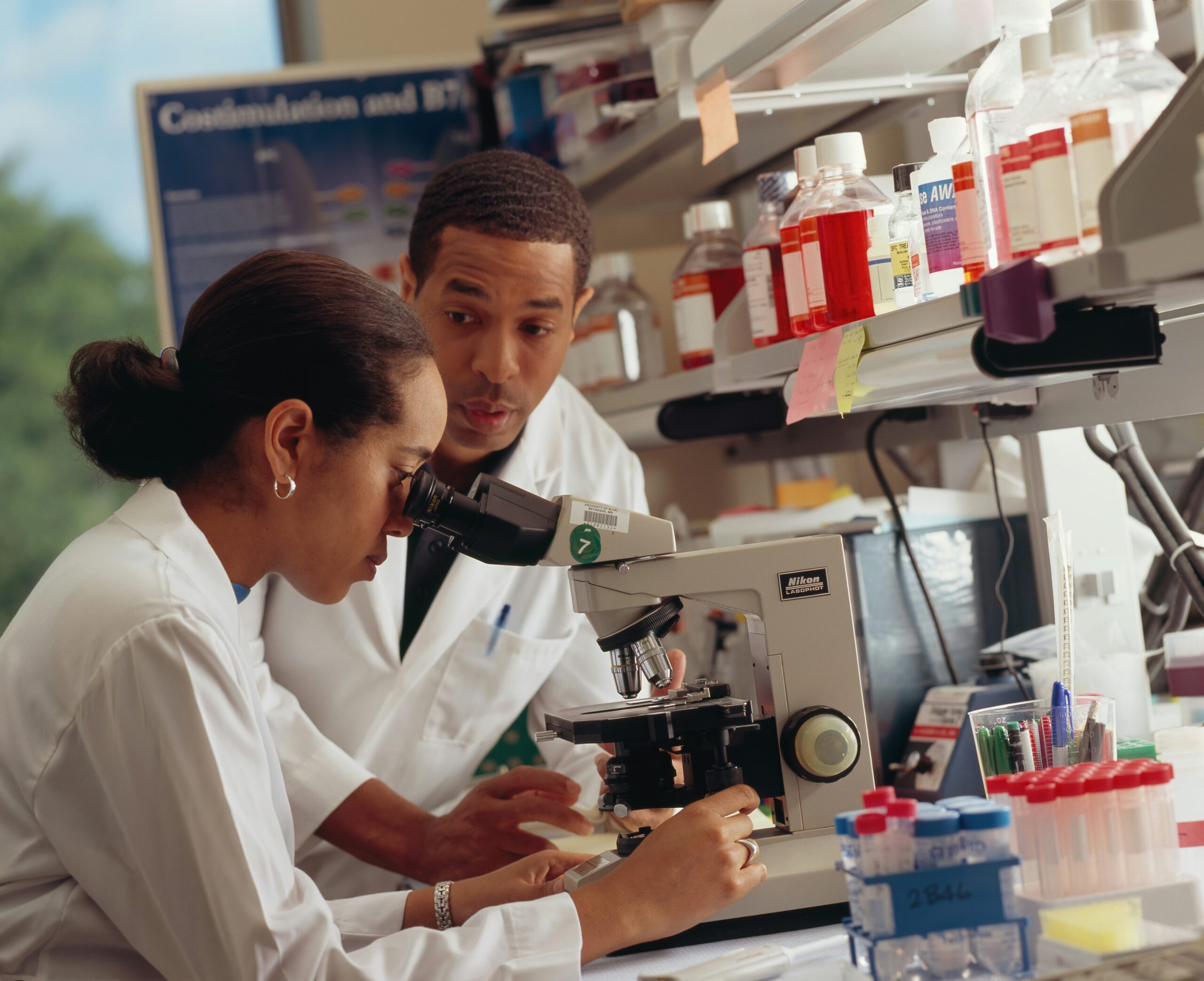
For decades, historically Black colleges and universities (HBCUs) have conducted research that elite institutions rarely prioritize such as on sickle cell disease, Black maternal health, and Black unemployment. Now, 15 HBCUs have formalized a collective push to earn the research credentials that would give their research a larger platform, more federal dollars, and a stronger claim to national influence.
On April 29, the Association of HBCU Research Institutions (AHRI) officially launched at Howard University in Washington, D.C.—the only HBCU in the country currently holding R1 Carnegie Classification status, which is the nation’s highest designation for research activity. The remaining 14 AHRI members, 13 of which hold R2 status, are aiming to close that gap. Their coalition office will be co-located with the Association of American Universities. They launch with a three-year, $1.05 million grant from Harvard University’s Legacy of Slavery Initiative.
The R1 bar is concrete and demanding, requiring at least $50 million in annual research expenditures and 70 doctoral degrees conferred each year. For institutions that have operated for generations with fewer resources than their predominantly White peers—a product of systemic inequity, not lack of ambition—those thresholds represent a significant hill to climb.

Yet the AHRI member schools collectively account for half of all competitively awarded federal research funding among HBCUs, a figure that underscores both their existing strength and the scale of what’s been missing from the national research conversation. “It’s the first time in the history of American higher education that a group of HBCUs has elevated themselves to the elite ranks of research institutions,” says David K. Wilson, EdD, president of Morgan State University and AHRI board chair.
The coalition’s partnership with Harvard carries particular symbolic weight. The Legacy of Slavery Initiative was created in 2022 after a presidential committee formally documented Harvard’s historical ties to the slave trade.
One of the committee’s recommendations called on the university to build enduring partnerships with HBCUs. The AHRI grant directly fulfills that charge, and Harvard’s Office of the Vice Provost for Research and Office for Sponsored Programs will provide hands-on technical assistance—hosting HBCU administrative staff at Harvard, helping with grant lifecycle management, and strengthening research compliance infrastructure across member institutions.
Ruth Simmons, PhD, the former president of Brown University, Smith College, and Prairie View A&M University, now serves as Harvard’s senior adviser on HBCU engagement. She was instrumental in the coalition’s formation. She described HBCUs’ long-standing isolation from dominant research networks as both a problem of structure and of assumption. “The whole notion that some people in this country are less important than other people has held us hostage for many, many years,” says Simmons.
The coalition model matters precisely because individual institutions working alone face steeper odds. Wayne A.I. Frederick, MD, interim president of Howard University and AHRI’s interim president, acknowledges that member schools carry significant infrastructure needs and face challenges recruiting enough faculty to study complex problems from multiple disciplinary angles.
A coordinated coalition can pool resources, share expertise, and present a unified voice to federal agencies and philanthropic funders in ways that no single institution could manage independently.
The research these colleges and universities are already producing illustrates what’s at stake. This year alone, Morgan State secured the first DARPA grant ever awarded to an HBCU for a $2.4 million project exploring how to convert nuclear radiation into electrical energy. A Howard University research team published findings on postpartum care gaps affecting Black mothers in both the United States and Ghana. A Texas Southern researcher received $100,000 to study firearm deaths among people recently released from incarceration.
“We are privileged to leverage our expertise in research infrastructure and capacity-building to help strengthen the foundation for HBCU research excellence and support more institutions on the path from R2 to R1 status,” says Sara Naomi Bleich, PhD, vice provost for special projects at Harvard.
These are not niche academic exercises. They are investigations into some of the most persistent and consequential failures of American society—pursued by institutions that have always understood, from the inside, what’s missing.
AHRI was formally incorporated in June 2023 and held its first board meeting that October. The public launch this spring coincided with the coalition’s inaugural research symposium, “Expanding the Research Mission of HBCUs,” convening university leaders, policymakers, and industry partners to map the path forward.
AHRI’s leaders have also issued a direct call to government agencies, corporations, and philanthropists to invest in the effort. Even though the destination is R1 status, the argument is that these HBCUs were always doing R1 work.