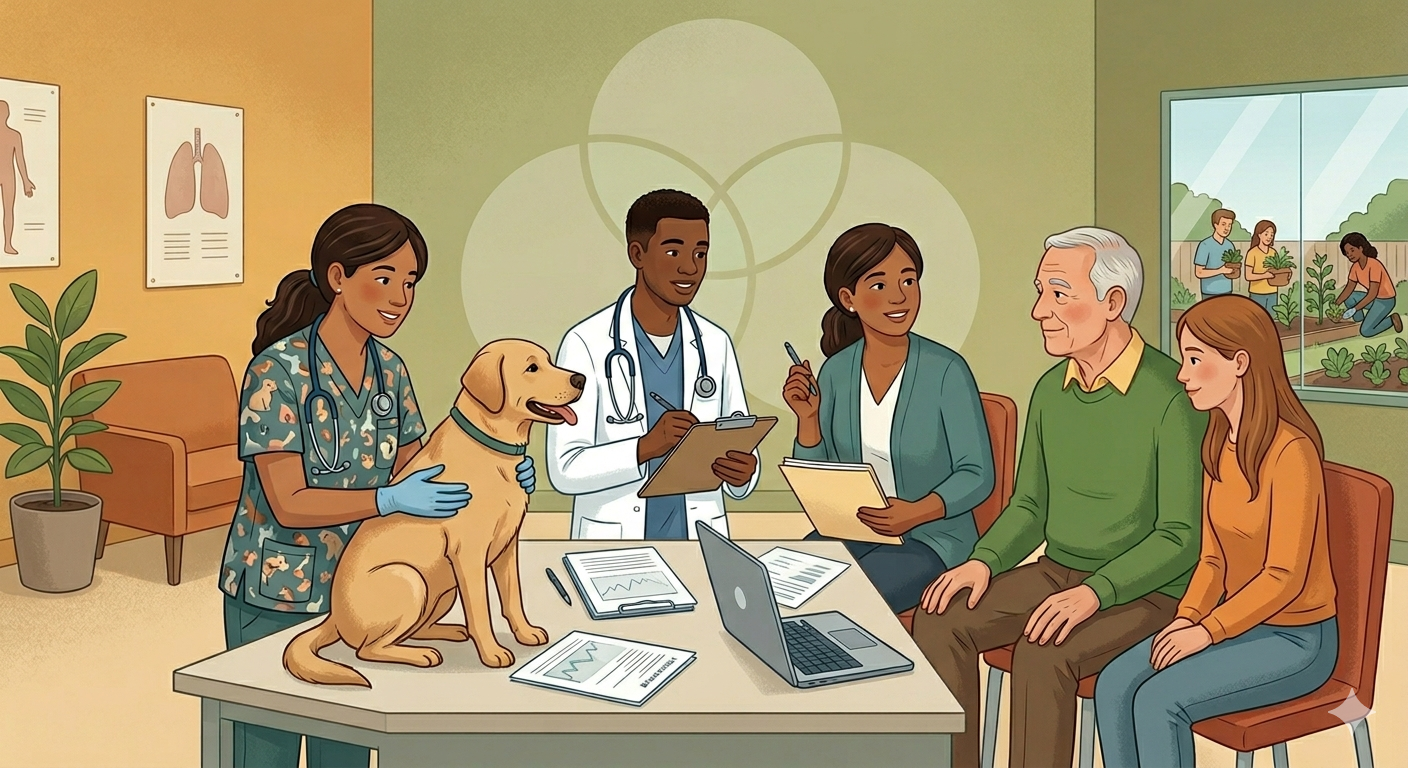
When a pet owner walks into WisCARES, the One Health access-to-care veterinary clinic at the University of Wisconsin-Madison, they’re often dealing with more than a sick pet.
They may be homeless, facing eviction, or managing a disability. Forty to fifty percent are people of color. Sixty to seventy percent report some form of physical, cognitive, or emotional disability. The veterinary students working those cases aren’t just learning to care for pets, they’re learning what it means to treat the entire family.
That’s precisely the point.
WisCARES, short for Wisconsin Companion Animal Resources, Education and Social Services, pairs veterinarians and veterinary nurses with social workers in an interprofessional, service-learning clinic for pet owners at or below 200% of the federal poverty level, or those experiencing homelessness.


Founded in 2013 through a collaboration between UW-Madison’s schools of veterinary medicine, pharmacy, and social work, it’s built on the recognition that in underserved communities, a pet’s health and a person’s wellbeing are rarely separable.
Social workers at WisCARES meet regularly with veterinary students to discuss poverty, homelessness, moral stress, and self-care.
WisCARES represents one expression of what the health professions world broadly calls One Health, the framework recognizing the interconnectedness of human, animal, and environmental health.
Nowhere is that more evident than at Midwestern University, which has embedded One Health as a foundational principle across its entire multi-campus operation. Karen Gruszynski, PhD, MPH, DVM, recently appointed as one of Midwestern’s One Health Initiative Coordinators, describes the goal.
“The One Health Initiative means that future healthcare providers will recognize that individual patient care doesn’t happen in a vacuum,” she says. “We hope that future healthcare providers will be able to use a One Health lens to optimize patient care, whether it is asking about pets in the household, educating about zoonotic disease risks, or adopting sustainable clinical practices.”
Midwestern has restructured coursework, clinical rotations, and community outreach across osteopathic medicine, pharmacy, dentistry, physical therapy, speech-language pathology, and veterinary medicine.
Students work through zoonotic disease, infections that spread between animals and humans, case studies in interprofessional groups. Veterinary and physical therapy faculty jointly run a canine rehabilitation program. College of Veterinary Medicine students have traveled with medical colleagues to Guatemala, treating thousands of human patients alongside their animals.
Gruszynski’s co-coordinator, Tiffany Hughes, PhD, who directs Midwestern’s public health program on its Glendale campus, stresses that One Health isn’t reserved for researchers or policymakers.
“One Health applies to everyone, whether they are going to be a practitioner at a local clinic or embarking on a veterinary practice,” Hughes says. “It can ripple in a macro perspective if they educate others about One Health.”
That perspective is backed by Gruszynski’s own research. A 2026 article in Frontiers in Medicine found that only 56% of 133 American medical schools included One Health in any form, while accredited veterinary schools are already required to incorporate it.
The profession focused on animals may be further ahead than the one focused on humans. Approximately 68% of North Americans live with at least one pet, meaning something as simple as asking about household animals could improve a physician’s ability to catch zoonotic disease and connect with patients.
Building this into packed professional curricula isn’t easy. Gruszynski documents real obstacles, attendance enforcement, facilitator shortages, faculty burnout, and notes that students resist anything that feels tangential to their licensing exams.
“Students will be dismissive of lectures, courses, and anything else that might be perceived as superfluous to their clinical training,” they write. “Therefore, it is imperative to demonstrate the importance of One Health to them as future practitioners.”
The evidence from programs that have pushed through those barriers is consistent. Students who participate in interprofessional, community-based experiences come back with sharper communication skills, stronger awareness of health equity, and something harder to measure but equally important: a more durable sense of why they chose their profession in the first place.
“Half of the battle is educating people about One Health, while the other is implementing One Health,” Hughes adds. “One Health not only needs to be integrated in education, but also into research and service. Broadly speaking, the sky is the limit when it comes to incorporating One Health in study and practice.”
Public health emergencies have a way of exposing the cost of silos. The institutions investing now in practitioners who can think across the boundaries of human, animal, and environmental health aren’t just improving their curricula, they’re building infrastructure the rest of the system will eventually need.