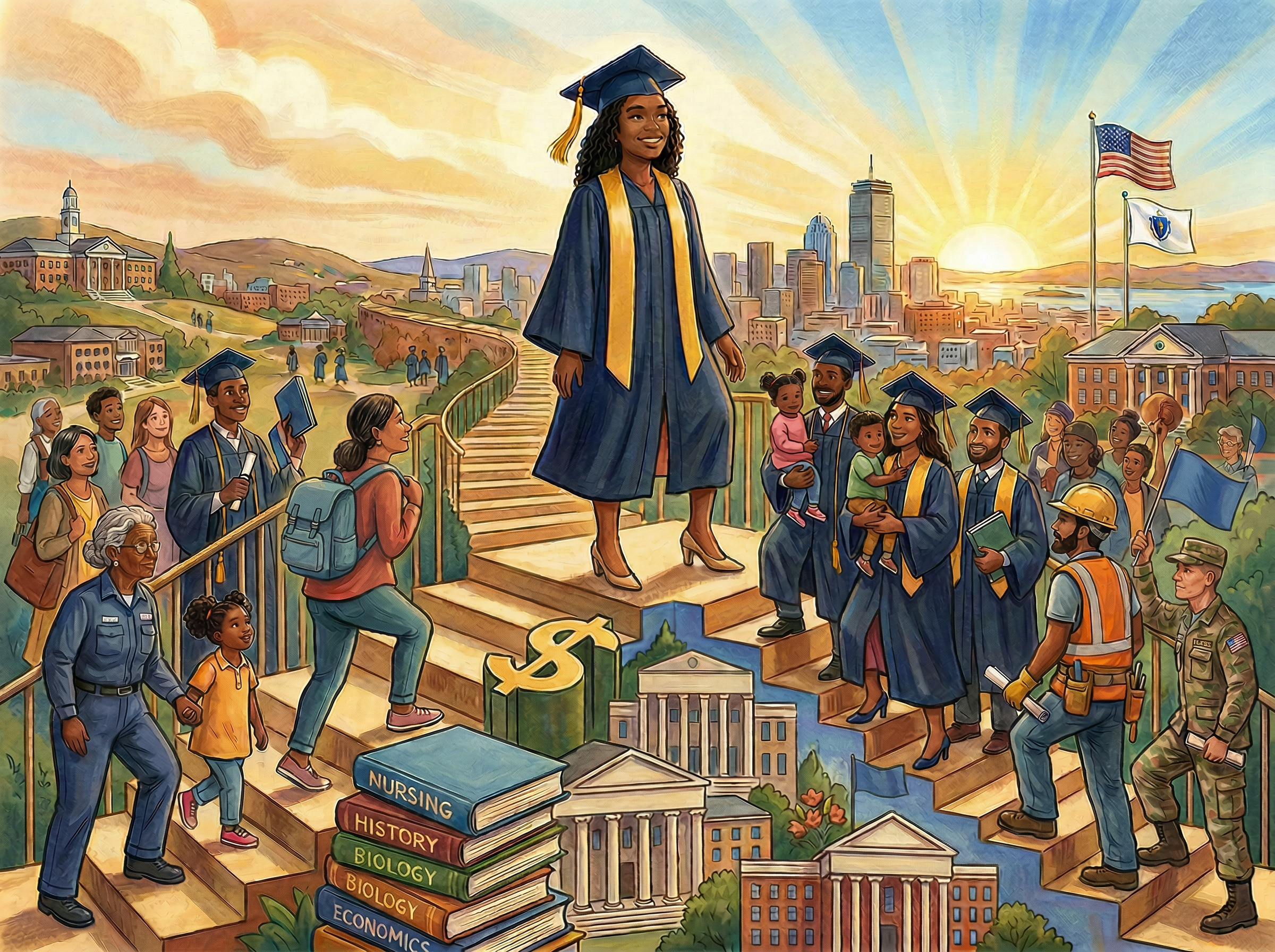
New investments fueled by the Massachusetts Fair Share initiative are reshaping the state’s higher education landscape, with billions of dollars translating into direct affordability gains for students and families. Since 2023, the policy has underwritten tuition-free community college for tens of thousands of state residents while substantially lowering the cost of four-year degrees at state public institutions.
At the community college level, $257.5 million in Fair Share funding has made no-cost enrollment available to all Massachusetts residents. According to state data, 50,751 students have enrolled in tuition-free community college programs. The expansion marks a significant shift in access, particularly as community college enrollment is growing for the first time since 2014.
State leaders have framed the investment as both an economic and workforce strategy. “Massachusetts community colleges are economic drivers, helping students move ahead in their careers and meeting the needs of our employers,” Gov. Maura Healey said.
For students like Krystin Woodard of Springfield, MA, the policy has had a direct and personal impact. Woodard left high school at 16 and later earned her GED. Financial challenges repeatedly interrupted her attempts to pursue higher education. After learning about the state’s no-cost community college programs, she enrolled at Springfield Technical Community College and completed her associate degree in liberal arts with honors alongside her sister, becoming the first in their family to graduate from college.

Fair Share dollars are also reducing costs at Massachusetts’ public universities. An additional $249 million expanded MASSGrant Plus, a financial aid program serving students at state universities and the University of Massachusetts (UMass) campuses. Under the expansion, low-income students pay no tuition and fees. Students from middle-income families can receive up to a 50% reduction in out-of-pocket expenses and have access to up to $1,200 for books and supplies.
For Graham Kratochwill, a UMass Dartmouth student, the aid provided financial certainty. “Now I don’t need to worry about that at all. I look at my bill—it says zero dollars and zero cents—I owe nothing,” he said.
Beyond tuition, Fair Share investments are addressing the broader financial pressures that can derail academic progress. The state distributed $30.5 million to public colleges and universities for student support services, including tutoring, childcare assistance, career counseling, debt counseling, and mental health services. Funds also help cover basic needs for transportation, emergency housing, and food. As of December 2025, $28.5 million has been distributed.
In addition to direct student aid, funds are being used to strengthen institutional capacity across the public higher education system. The state set aside $165 million for campus infrastructure improvements, including modernization of laboratories, upgrades to clinical skills simulation facilities, accessibility enhancements, and overdue maintenance projects. In the 2024 fiscal year alone, $50 million supported improvements to 200 buildings across 29 public institutions, with an additional $115 million allocated in the 2025 fiscal year supplemental budget to continue modernization efforts.
Together, the Fair Share investments signal a state-led model that ties tax policy to direct education funding. The early results—tuition-free community college for more than 50,000 students, expanded four-year aid, and growing enrollment—suggest that Massachusetts is testing a comprehensive approach to affordability that extends from high school through college.