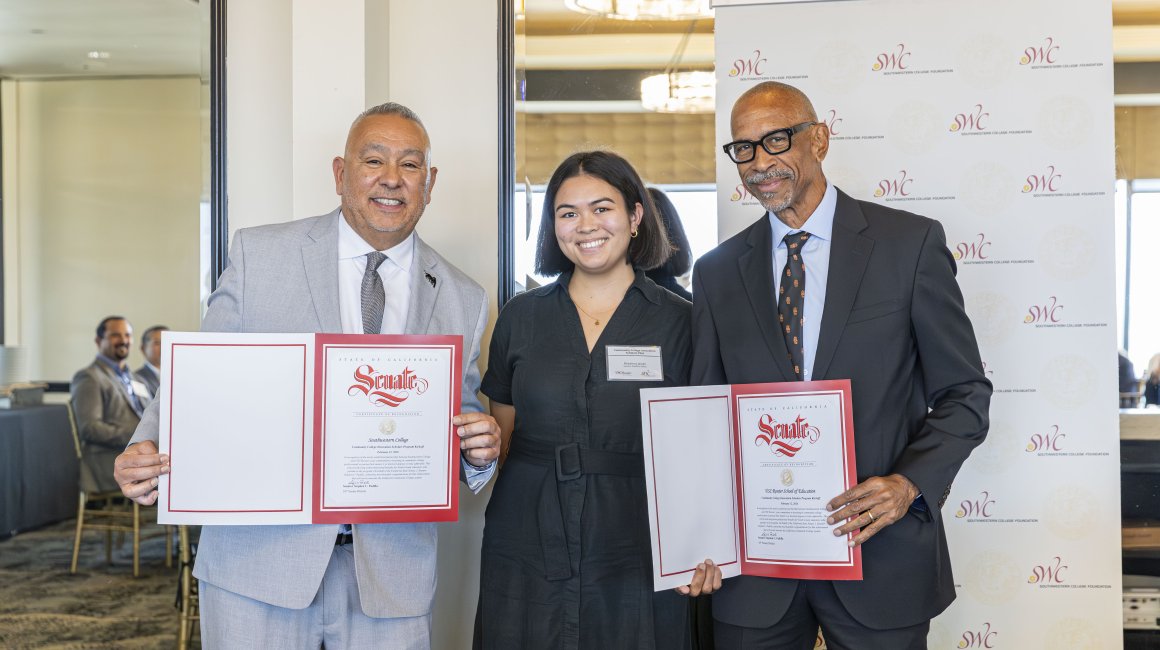
A new graduate education initiative is bringing one of the nation’s most prestigious universities directly to a community college campus in Chula Vista, California, and its backers say the stakes extend well beyond the two partners.
University of Southern California’s Rossier School of Education (USC Rossier) has partnered with Southwestern College to launch the Community College Innovation Scholars Program, a three-year, $4.2 million pilot that will allow up to 120 Southwestern faculty, staff, and administrators to earn graduate degrees without leaving their jobs or community.
Beginning in fall 2026, participants can pursue either a Master of Education in Learning Design with AI and Emerging Technologies or a Doctor of Education in Organizational Change and Leadership.
USC Rossier faculty will deliver coursework through a hybrid format—combining online instruction, in-person classes at Southwestern’s Chula Vista campus, and immersive weekend experiences at USC’s University Park Campus in Los Angeles.


The program is designed with the realities of working professionals in mind.
“It’s hard when you’re a working professional to be able to commute to USC to take classes,” Pedro Noguera, PhD, dean of USC Rossier, said at the launch of the program. “A lot of those classes can be offered online. But we can enhance them with immersive learning experiences where we bring our faculty to Southwestern. That’s the model we’re creating here.”
That model draws on a template USC has used internationally.
“We have global programs where we bring our faculty to places like Singapore, Finland, South Africa, and Brazil,” Noguera said. “Why not Southwestern Community College?”
The urgency behind the initiative is rooted in the data. California’s community college system—the largest system of higher education in the country with 116 institutions—serves more than 2.1 million students annually. Roughly one-third of all California high school graduates begin their higher education journey at a community college, making them a critical entry point, particularly for first-generation students, low-income learners, and working adults. Yet student completion rates hover at around 30%.
Leadership instability compounds the challenge. As of 2025, the average tenure for a community college leader had dropped to just 4.3 years, with limited succession pipelines and few meaningful pathways for professional advancement among faculty and staff.
“Addressing student success at scale requires parallel investment in the people and leadership structures that shape institutional change, and that’s one major aspect of what we aim to do with this new program,” Noguera said.
Each scholar in the program will complete an applied research project targeting real institutional challenges—from closing equity gaps and improving student persistence to strengthening workforce pathways. Collectively, participants are expected to produce up to 120 peer-reviewed research studies, creating what program organizers describe as a built-in engine for institutional improvement.
Southwestern College President and Superintendent Mark Sanchez, EdD, who was instrumental in spearheading the program, noted that it will serve as a strong workforce development strategy for the broader San Diego–Tijuana binational region.
“Today’s project kickoff represents the culmination of a vision that began years ago—a vision for innovation in higher education and transformation in South San Diego County,” he said. “This program is more than a degree opportunity, it is a pipeline to leadership.”
Program organizers say the Southwestern pilot is intended as a replicable model—one that could eventually be scaled across California’s community college system. The program’s first cohort is expected to begin coursework in fall 2026.